How to Optimize for Google AI Overviews: A B2B Technical Guide
What Are Google AI Overviews and Why B2B Marketers Must Act Now
Google AI Overviews (formerly SGE) are AI-generated summaries that appear at the top of search results, synthesizing content from multiple sources to answer a query directly. For B2B marketers, the core question is: how do you get your content cited in these overviews?
The short answer: you need to produce content that is authoritative, structured, and directly answers the specific questions your buyers type into Google. AI Overviews pull from pages that demonstrate clear topical expertise, use structured data, and provide concise, verifiable answers not pages optimized purely for keyword density.
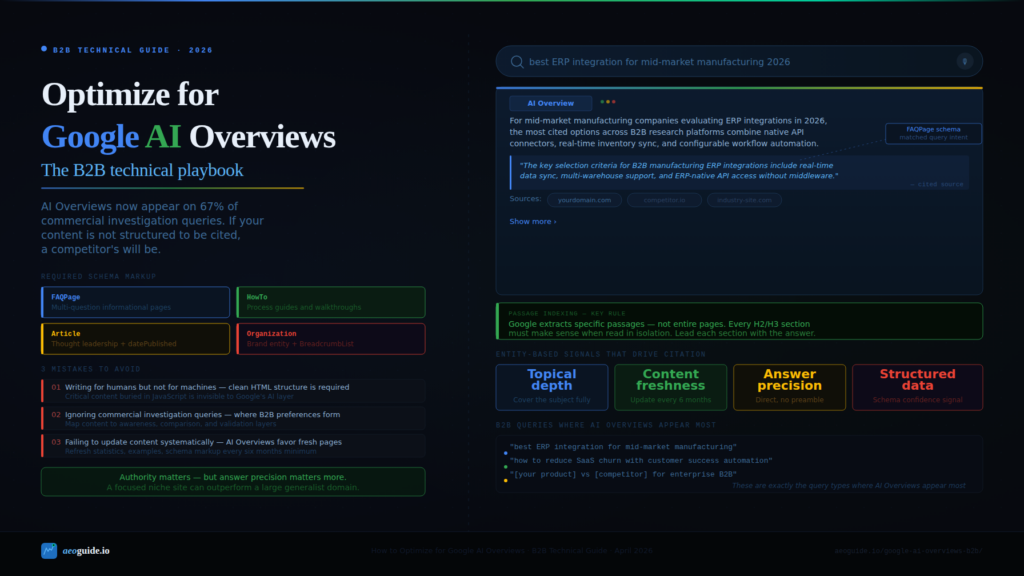
This matters more in B2B than anywhere else. Your buyers run long, specific queries: “best ERP integration for mid-market manufacturing,” “how to reduce SaaS churn with customer success automation.” These are exactly the types of queries where AI Overviews now appear most frequently. If your content is not structured to be cited, a competitor’s will be.
Google’s AI Overviews are not a future trend. As of 2024, they appear on a significant share of informational and commercial investigation queries in the US, with rapid expansion globally. B2B content teams that wait will find their organic traffic eroding without understanding why.
Technical Optimization Strategies to Appear in Google AI Overviews
Structure Your Content Around Entity-Based Answers
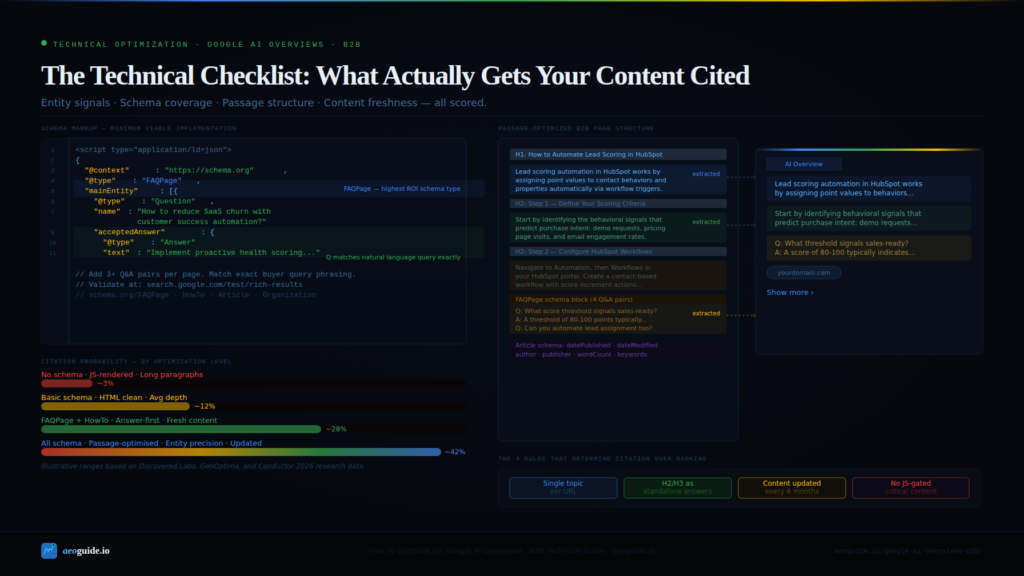
Google’s AI layer is built on entity recognition and knowledge graph logic. This means your content needs to clearly define what it is about, who it is for, and what problem it solves, not just contain the right keywords. Each page should have a single, unambiguous topic focus. Use your H1 and first paragraph to establish the entity: the product, concept, or process you are addressing.
For B2B content, this translates into pages that answer one specific buyer question per URL. A page titled “How to Automate Lead Scoring in HubSpot” will outperform a generic “Lead Scoring Guide” in AI Overview citations because the query intent is precise and the entity match is stronger.
Use Schema Markup Strategically
Structured data is not optional if you are serious about AI Overview visibility. Implement the following schema types depending on your content format:
- FAQPage schema for pages that answer multiple related questions in a single article.
- HowTo schema for process-driven content like setup guides, integration walkthroughs, or methodology breakdowns.
- Article schema for thought leadership and analysis pieces, including datePublished and author markup to signal freshness and authority.
- Organization and BreadcrumbList schema to reinforce site structure and brand entity recognition.
Google’s AI systems use structured data as a confidence signal. When your markup matches your visible content, you reduce ambiguity for the model and increase the probability of citation.
Q&A: Does Page Authority Still Matter for AI Overviews?
Question: Do you need high domain authority to appear in Google AI Overviews?
Authority matters, but it is not the primary gate. Google’s AI Overviews have been observed citing mid-authority domains when their content provides the most direct, structured answer to a specific query. What consistently matters more than raw domain authority is: topical depth (do you cover the subject comprehensively?), content freshness (is the page updated regularly?), and answer precision (does your content directly address the query without burying the answer?).
For B2B marketers, this is actually good news. A focused niche authority site, even with a modest backlink profile, can outperform a large generalist domain if its content is better structured and more specific to the buyer’s query.
Optimize for Passage Indexing and Chunk Readability
Google does not always cite an entire page. It extracts specific passages. This means every section of your content needs to stand alone as a coherent answer. Write your H2 and H3 sections so that they make sense when read in isolation. Lead each section with the answer, then provide supporting context. Avoid burying key information in the middle of long paragraphs.
Aim for paragraphs of three to five sentences maximum. Use numbered lists for processes. Use definition-style openings for conceptual explanations. These formats are significantly more likely to be extracted by AI systems as citable passages.
Read our strategic playbook about AEO to learn more.
Common Mistakes B2B Teams Make and How to Fix Them
Writing for Humans but Not for Machines
The biggest error is treating AI Overview optimization as purely a UX exercise. Your content needs to be readable by humans and parseable by machines simultaneously. This means clean HTML structure, no critical content buried in JavaScript, and semantic heading hierarchies that reflect the actual logical structure of your argument.
Run a crawl of your key B2B pages with a tool that renders JavaScript. If your headings and body content do not appear cleanly in the rendered HTML, Google’s AI layer may not be reading what you think it is.
Ignoring the Commercial Investigation Layer
B2B buyers do not jump straight to demo requests. They go through a research phase that now heavily involves AI-generated answers. If your content only targets bottom-funnel keywords, you are invisible during the phase where preferences are actually formed. Map your content to the full query journey: awareness queries, comparison queries, and validation queries. Each layer needs dedicated, structured pages.
Failing to Update Content Systematically
AI Overviews favor fresh content. A page last updated in 2022 will lose citations to a competitor who refreshed theirs in Q1 2025. Build a content maintenance calendar specifically for your highest-traffic B2B pages. Update statistics, add new examples, and revise schema markup at least every six months.
Conclusion
Optimizing for Google AI Overviews in a B2B context is not about gaming an algorithm. It is about producing the most precise, structured, and authoritative answer to the questions your buyers are already asking. The technical foundations: schema, passage readability, entity clarity, are non-negotiable. The strategic layer: query mapping, topical depth, content freshness, is what separates teams that get cited from those that get bypassed.
If you want to audit your current B2B content against AI Overview readiness criteria, explore the AEO audit frameworks and tools available on aeoguide.io. The gap between where your content is today and where it needs to be is almost always smaller than it looks, once you know exactly what to fix.
Discover the new article : How to mesure AEO ROI