How to Measure AEO ROI: The Metrics That Actually Matter for B2B
How do you measure the ROI of AEO in a B2B context? You track a specific set of leading and lagging indicators tied to answer engine visibility, pipeline influence, and brand authority — not just organic traffic.
This is the core challenge every B2B marketing team faces when investing in Answer Engine Optimization. Traditional SEO metrics — rankings, impressions, click-through rates — only tell part of the story. When your content is cited by Perplexity, summarized by SearchGPT, or pulled into a Gemini overview, the user may never click through. The value is real. The attribution is not obvious.
B2B buying cycles are long. Decision-makers use AI-powered search tools to shortlist vendors, validate solutions, and benchmark options before ever filling out a form. If your brand is not showing up in those answers, you are invisible at the most critical stage of the funnel. Measuring AEO ROI means building a framework that captures that influence, even when it does not generate a direct last-click conversion.
Be sure to understand what is AEO
The Right Metrics Framework for AEO in B2B
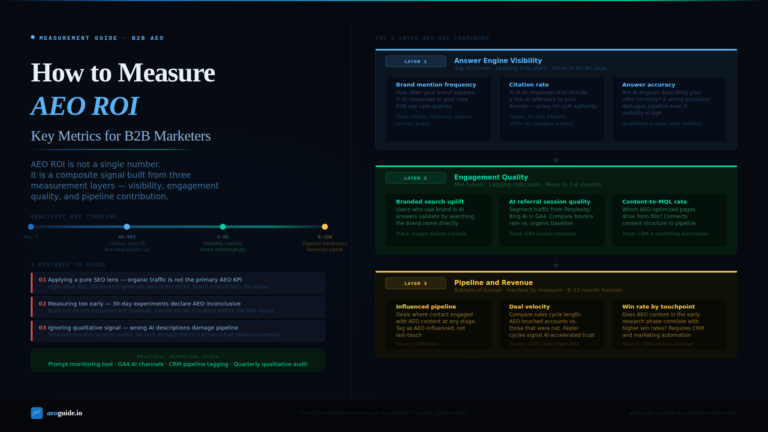
Before diving into specific KPIs, one distinction matters: AEO ROI is not a single number. It is a composite signal built from three measurement layers — visibility, engagement quality, and pipeline contribution.
Layer 1: Answer Engine Visibility Metrics
This is your top-of-funnel AEO signal. You are measuring how often and how accurately your brand appears in AI-generated responses across platforms like Perplexity, ChatGPT, Gemini, and Bing Copilot.
Key metrics to track:
1. Brand mention frequency in AI responses — Run structured prompt tests on your core B2B use cases and track how often your brand, product, or content is cited. Tools like Profound, Otterly.ai, or manual prompt audits can support this.
2. Citation rate — Of all the AI responses that mention your topic, what percentage include a link or reference to your domain? This is a direct proxy for content authority in LLM training and retrieval pipelines.
3. Answer accuracy and framing — Are the AI engines describing your offer correctly? A wrong summary can damage pipeline quality even if visibility is high. Qualitative audits matter here.
Layer 2: Engagement Quality Metrics
When users do click through from an AI-assisted search, the quality of that traffic tends to be higher. Track these signals specifically:
1. Branded search volume uplift — An increase in direct brand queries after AEO investment is one of the strongest indirect ROI signals. Users who encountered your brand in an AI answer often validate by searching your name directly.
2. Session depth and time on site from AI referral traffic — Segment traffic coming from Perplexity, Bing AI, and similar sources in GA4. Compare bounce rate and pages-per-session against your SEO baseline.
3. Content-to-demo or content-to-MQL conversion rate — Which AEO-optimized pages are driving form fills? This connects content structure decisions directly to pipeline contribution.
Q&A: What Is a Realistic AEO ROI Timeline for B2B?
Q: How long before AEO investment shows measurable ROI in a B2B context?
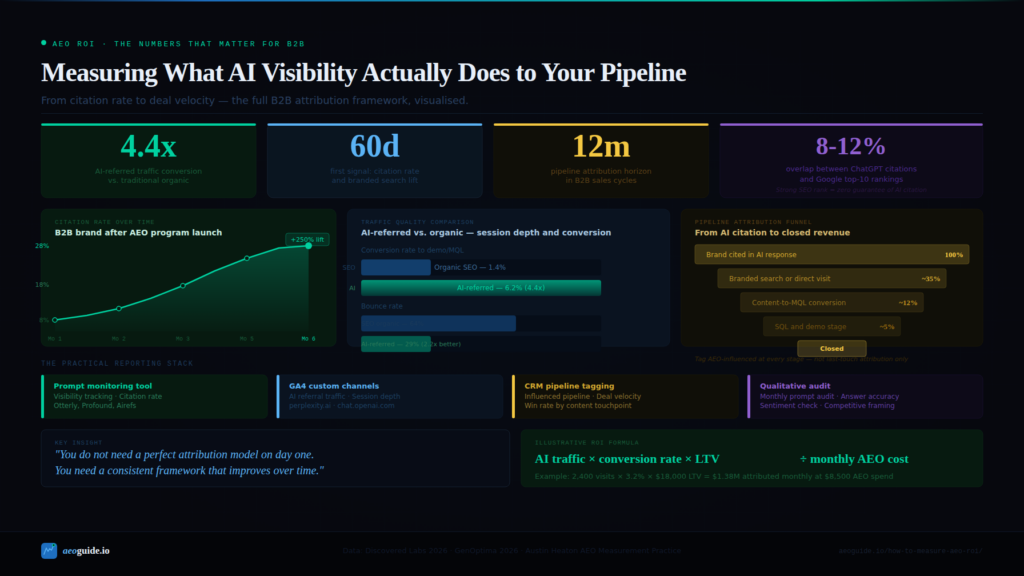
A: Expect a 3 to 6 month lag before visibility metrics move meaningfully. Pipeline attribution takes longer — typically 6 to 12 months — because B2B sales cycles are extended and multi-touch. The earliest signals you will see are branded search volume increases and citation rate improvements, usually within 60 to 90 days of a structured AEO content push. Set stakeholder expectations accordingly and anchor early reporting on leading indicators, not revenue.
Layer 3: Pipeline and Revenue Attribution
This is the hardest layer to measure and the most important to get right for B2B leadership buy-in.
1. Influenced pipeline — Use CRM data to identify deals where a contact engaged with AEO-optimized content at any stage. Tag this as AEO-influenced pipeline, not just last-touch.
2. Deal velocity in AEO-touched accounts — Compare average sales cycle length for accounts that engaged with your answer-engine-visible content versus those that did not. Faster cycles indicate that AI-assisted discovery is accelerating trust-building.
3. Win rate by content touchpoint — If your AEO content appears in the early research phase, does it correlate with higher win rates? This requires tight CRM and marketing automation alignment but delivers the most credible ROI narrative.
Common Mistakes B2B Teams Make When Measuring AEO ROI
The most frequent error is applying a pure SEO measurement lens to AEO. Organic traffic is not the right primary KPI. Many high-value AEO placements generate zero direct clicks — the value is in brand imprinting and shortlist inclusion, not session counts.
A second mistake is measuring too early. B2B marketers who run a 30-day AEO experiment and declare it inconclusive are setting themselves up for budget cuts. Build a 6-month measurement roadmap from the start and communicate it upward before the first report is due.
A third mistake is ignoring qualitative signal. If Perplexity is describing your product incorrectly or attributing your competitor’s features to your brand, no click-through metric will catch that. Schedule monthly prompt audits as a non-negotiable part of your AEO operations.
The Reporting Stack That Works
For most B2B teams, a practical AEO ROI reporting stack combines four elements: a prompt monitoring tool for visibility tracking, GA4 with custom channel groupings for AI referral traffic, CRM pipeline tagging for influenced revenue, and a quarterly qualitative audit of AI response accuracy.
You do not need a perfect attribution model on day one. You need a consistent measurement framework that improves over time and gives leadership a credible narrative.
If you are building that framework from scratch, the AEO Strategy section on aeoguide.io covers the full measurement architecture — from prompt audit templates to CRM tagging logic — built specifically for B2B marketing teams.