AEO vs SEO: The Shift B2B Marketers Cannot Ignore in 2026
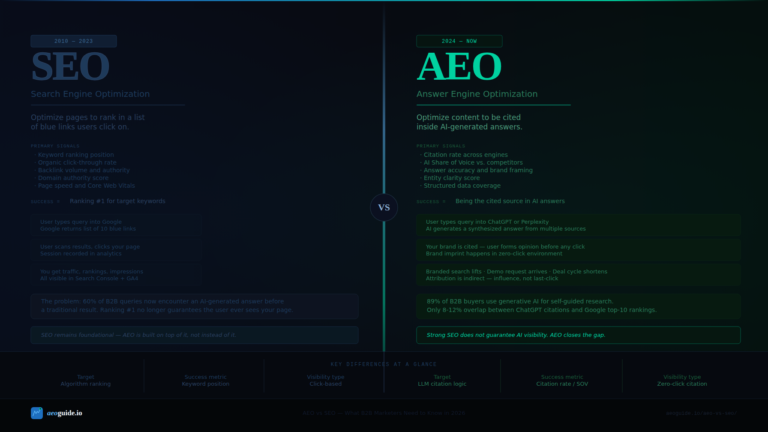
What is the difference between AEO and SEO? SEO (Search Engine Optimization) focuses on ranking web pages in traditional search engines like Google through keywords, backlinks, and technical signals. AEO (Answer Engine Optimization) goes further: it structures content so that AI-powered answer engines — Perplexity, SearchGPT, Gemini, Claude — can extract, cite, and surface your content directly in conversational responses, often without a click ever happening.
For B2B marketers, this distinction is no longer academic. Buyers are increasingly starting their research through AI assistants. They ask questions, get synthesized answers, and form vendor shortlists before ever visiting a website. If your content is not optimized for answer engines, you are invisible at the most critical stage of the buying journey.
The rules are changing fast. In 2024, AI-generated overviews became standard in Google Search. By 2026, the majority of B2B research queries will be partially or fully answered by an AI layer before a human clicks anything. The question is not whether to care about AEO. The question is how quickly you can adapt.
SEO vs AEO: Core Differences That Matter for B2B Strategy
How SEO and AEO Diverge in Practice
Traditional SEO is built around a relatively stable set of signals: keyword relevance, domain authority, page speed, structured data, internal linking. The goal is to rank in a list of blue links. Success is measured in organic traffic, impressions, and click-through rates.
AEO operates on a different logic. Answer engines do not rank pages — they synthesize information from multiple sources and generate a response. Your content needs to be citable, not just rankable. That means clarity of structure, factual precision, semantic authority, and a format that makes it easy for a language model to extract a coherent answer.
Concretely, the differences break down like this:
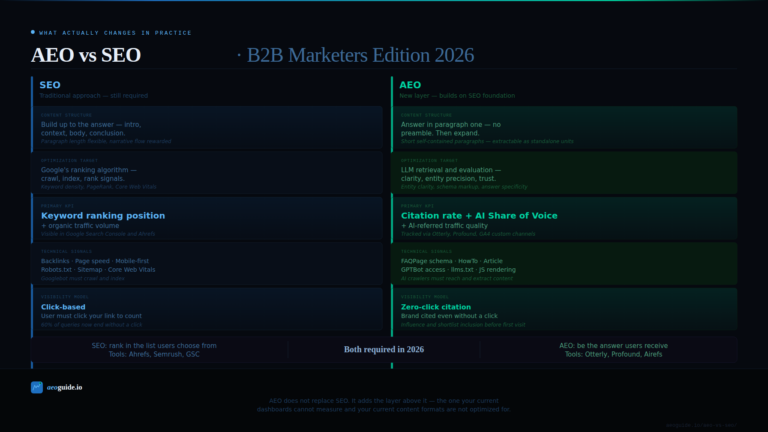
1. Intent targeting: SEO targets keywords. AEO targets questions and the intent behind them — especially the specific, high-stakes questions B2B buyers ask mid-funnel.
2. Content format: SEO rewards long-form content with keyword density and backlink signals. AEO rewards structured, direct answers — definitions, comparisons, numbered steps, and concise factual statements.
3. Success metrics: SEO is measured by rankings and traffic. AEO success looks like citation frequency in AI responses, brand mentions in Perplexity answers, and share of voice in AI-generated summaries.
4. Authority signals: Both rely on credibility, but AEO places higher weight on topical depth, consistency of information across the web, and structured data markup (FAQ schema, HowTo schema, Speakable schema).
Does SEO Still Matter If You Invest in AEO?
Yes — and significantly. AEO does not replace SEO; it extends it. Answer engines still pull from indexed, high-authority pages. A weak SEO foundation undermines your AEO performance. Think of SEO as the infrastructure and AEO as the layer that determines whether your content gets cited in AI responses. You need both, but the weighting is shifting. In 2026, content that is technically sound for SEO but structurally invisible to AI models will underperform in the channels where B2B buyers now spend the most time.
Discover also how to mesure ROI of AEO
How B2B Marketers Should Adapt Their Content Strategy for AEO
Actionable Steps to Optimize for Answer Engines
1. Map your content to explicit questions. Audit your existing content and identify which pages answer specific buyer questions. Reframe headings as questions where it makes sense. AI models are trained to match questions to answers — help them do it.
2. Use structured data systematically. Implement FAQ schema on product and solution pages. Use HowTo schema for process-oriented content. These signals are direct inputs for how Google’s AI overviews and other engines interpret your content.
3. Write answer-first paragraphs. Every major section should open with a clear, self-contained answer to the implicit question of that section. Do not bury the answer in the third paragraph. AI engines extract the first coherent response they find.
4. Build topical authority, not just keyword coverage. A single page ranking for a keyword is a SEO play. A cluster of interlinked, deeply accurate content on a topic is an AEO play. Answer engines favor sources that demonstrate consistent, comprehensive knowledge across a subject area.
Mistakes B2B Marketers Make When Transitioning to AEO
The most common mistake is treating AEO as a content formatting exercise. Adding FAQ sections to existing thin content does not work. Answer engines evaluate the quality and trustworthiness of the underlying information, not just its structure.
Another frequent error is ignoring off-site signals. Your brand’s presence in third-party publications, industry directories, and authoritative forums directly influences whether AI models consider you a credible source worth citing. B2B brands that invest only in owned content miss half the AEO equation.
Finally, many marketers fail to measure AEO performance because they rely on traditional analytics. Organic traffic from AI-assisted queries is often unattributed or underreported. Start tracking brand citation frequency in tools like Perplexity manually or through emerging AEO monitoring platforms.
Where to Go From Here
The B2B buying journey in 2026 runs through AI interfaces before it runs through search results pages. Marketers who understand both SEO and AEO, and know when to apply each, will hold a structural advantage over those still optimizing exclusively for blue links.
If you are building or refining your AEO strategy, the AEO Guide resource library covers everything from technical implementation to content frameworks built specifically for answer engine visibility. Start with the AEO strategy section to benchmark where your current content stands.