Best GEO Tools (2026): Track Your AI Visibility Across ChatGPT, Perplexity & Google AI
What are the best AEO trackers in 2026?
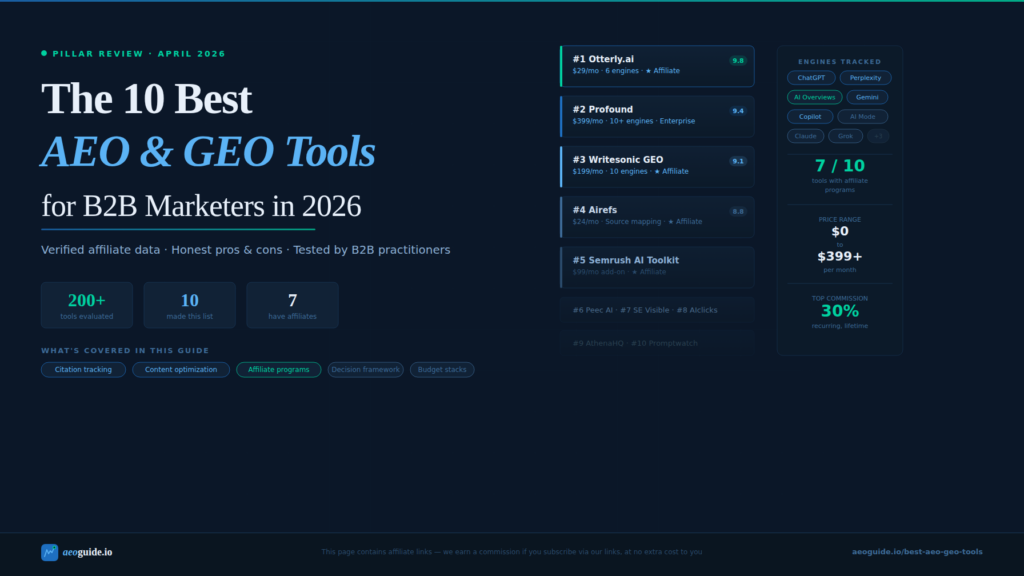
The six best AEO trackers for B2B marketers in 2026 are Otterly AI (best entry point, $29/month), Profound (best enterprise platform, $399/month effective), Peec AI (best for agencies, from $89/month), Scrunch AI (best for technical AEO, from $300/month), Writesonic GEO (best for content teams, $199/month), and the Semrush AI Visibility Toolkit (best for existing Semrush users, $99/month add-on). Below is a scored comparison covering pricing, platform coverage, data freshness, actionability, and B2B fit.
We spent several weeks testing, comparing, and re-testing the main AEO and GEO platforms available in 2026. We ran real queries in ChatGPT, Perplexity, and Google AI Overviews. We checked citation data against what platforms reported.
The short version: the market is maturing fast but remains uneven. Three or four tools are genuinely excellent. Several are overpriced for what they deliver. A couple are outright expensive experiments dressed up with funding press releases. We’ll tell you which is which.
Why AEO tools became a category overnight
As recently as early 2024, there was no meaningful market for AEO-specific tooling. Marketers who wanted to track their brand in AI-generated answers did it manually: typing queries into ChatGPT, copying outputs into spreadsheets, and comparing week over week. It worked, sort of, for teams tracking three or four prompts across one engine.
Then two things happened simultaneously. First, AI search usage exploded. ChatGPT crossed 100 million daily active users. Perplexity carved out a meaningful share of B2B research queries. Google AI Overviews started appearing on 15-25% of traditional searches. Second, Profound raised $58.5 million across several rounds, which signalled to the market that ‘AEO platform’ was a viable business category. By Q1 2026, there were over 200 tools claiming to offer AEO or GEO capabilities.
The problem with 200+ tools in a nascent category is that most of them are not very good. Some are SEO tools that bolted an ‘AI visibility’ module onto their existing dashboard without rebuilding the underlying data pipeline. Some are funded startups with impressive pitch decks and beta-quality products. A few are genuinely excellent platforms built from the ground up for the AEO use case.
Our job in this guide is to separate those categories with enough specificity to be useful to a B2B marketing team that needs to make a real purchasing decision.
How we evaluated these tools
We assessed each tool against five criteria, weighted by relevance to B2B marketing teams:
- AI engine coverage (30%): Which engines does the tool track, at which plan tier? A tool that covers ChatGPT only at its entry price is not a serious AEO platform.
- Data accuracy and freshness (25%): How well does reported citation data match what we observed manually? How frequently is data updated?
- Actionability (25%): Does the tool tell you what to do with the data, or just show you a dashboard? The best tools close the loop between insight and action.
- Pricing transparency and value (15%): Is the published pricing the real working price? We note where entry pricing is misleading relative to functional capability.
- B2B fit (5%): Does the tool suit multi-stakeholder buying environments, team collaboration, and client reporting?
The 10 best AEO & GEO tools for B2B marketers in 2026
Otterly.ai
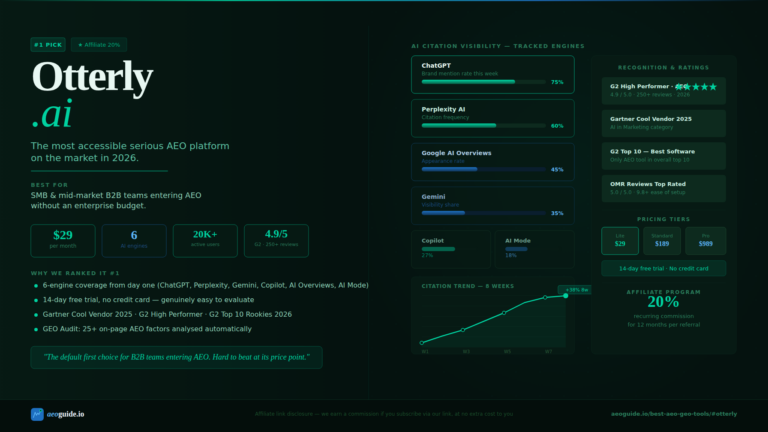
Otterly.ai has earned its position at the top of this list not by being the most feature-rich platform, but by doing the fundamentals exceptionally well at a price point that makes AEO accessible to teams that are not yet running eight-figure marketing budgets. At $29/month for the Lite plan, it is the lowest entry point for genuine multi-engine citation tracking in the market.
The platform covers six AI engines — ChatGPT, Google AI Overviews, Google AI Mode, Perplexity, Gemini, and Copilot — and tracks brand mentions, citation URLs, sentiment, and competitive positioning across all of them. The GEO Audit feature analyses over 25 on-page factors and provides specific optimization recommendations, which is a meaningful bonus at this price point that most entry-tier tools omit.
The third-party validation is hard to dismiss: Gartner Cool Vendor 2025 (AI in Marketing), G2 High Performer in the AEO category, ranked #10 overall in G2’s 2026 Best Software Awards — the only AEO tool to make that broader list. 20,000+ marketing and SEO professionals across 40+ countries use the platform, and its 4.9/5 rating across 250+ reviews carries meaningful signal. A case study from Bacula Enterprise documented reaching the #1 position in ChatGPT answers for their target category after using Otterly to fine-tune prompt coverage. That kind of specific, verifiable outcome matters more than most marketing copy.
The honest limitations: Otterly is monitoring-first. It will show you the problem with great clarity; it will not write the content fix for you. For teams that want tracking and content production in a single tool, Writesonic GEO is the better choice. Otterly also becomes expensive at volume — the Standard plan at $189/month and Pro at $989/month are significant jumps from the Lite entry point, and the pricing-per-prompt model can catch teams off guard as their tracking scope grows.
The default first choice for B2B teams entering AEO. Hard to beat at its price point.
Profound
For enterprise teams, it is the strongest platform in the category by a meaningful margin — and if we ranked it lower out of financial self-interest, we would be exactly the kind of publication we tell our readers to distrust.
The funding trajectory tells part of the story. Seed from Khosla Ventures, Series A from Kleiner Perkins plus NVIDIA, Series B from Sequoia, Series C from Lightspeed — $155 million total raised. The customer list is equally impressive: Ramp, MongoDB, Figma, Zapier, Docusign, Walmart, LG, Target. These are brands with serious procurement processes. The fact that Profound cleared enterprise security reviews at those organisations (SOC 2 Type II, SSO, RBAC, HIPAA) means the infrastructure is real.
What separates Profound from monitoring-heavy competitors is its prompt volume data — the only platform in the category that shows how frequently users are actually querying AI engines about topics in your space (from a database of 400M+ actual AI conversations via their Conversation Explorer). When you combine that with real-time citation tracking across 10+ engines and the Agents content generation feature, you have a closed-loop AEO program: find the high-volume prompts where you are not cited, generate optimised content designed to close those gaps, measure whether the content drives citation improvement.
The real talk on pricing: the $99/month Starter plan is essentially a product demonstration. It covers ChatGPT only, with 50 prompts — not a real AEO program. The effective working entry price is $399/month (Growth), which covers three platforms. Full engine coverage (Claude, Gemini, Grok, and others) requires custom Enterprise pricing. For teams that cannot justify $399/month as an experiment, start with Otterly or Airefs and revisit Profound when your AEO program has demonstrated enough ROI to justify the budget step-up.
The best enterprise AEO platform. Not the right choice for teams that cannot commit $399/mo seriously.
Writesonic
Writesonic started as an AI writing tool, one of the better-regarded ones, with 5M+ users and a solid reputation in content marketing circles. Its evolution into a GEO platform is not a bolt-on; the company rebuilt meaningful sections of the product around the question of how to help brands appear in AI-generated answers, not just rank in traditional search. The result is the most complete workflow tool in the AEO category for teams that also need to produce content.
The core differentiator is the action layer. Most AEO tools show you the gap, your brand is not cited when a buyer asks ChatGPT about your category. Writesonic GEO shows you the gap and then gives you the tools to close it: a content brief optimised for AI citation, an AI article writer, an SEO checker, an AEO content scorer, and competitor analysis in a single dashboard. For content teams that would otherwise toggle between four different tools, the consolidation has real value.
The GEO tracking covers 10 AI platforms including ChatGPT, Google AI Overviews, Google AI Mode, Perplexity, Microsoft Copilot, Gemini, Grok, Meta AI, Claude, and DeepSeek — one of the broadest coverage sets in the market. The Brand Presence Explorer tracks both citation frequency and sentiment, which matters for B2B brands where the tone of how an AI describes you affects buyer perception.
The important caveat: GEO features are locked to the Professional plan ($199/month annual) and above. The $49/month Individual plan does not include AI visibility tracking. If you are evaluating Writesonic purely as an AEO monitoring tool, the effective entry price is $199/month, not $49. At that price point, you are essentially buying a content production platform with AEO tracking included, which is the right frame if you need both capabilities. If you only need tracking, Otterly at $29/month is more cost-efficient.
The best choice for content teams who want AEO tracking and content production without running two separate platforms.
AiRefs
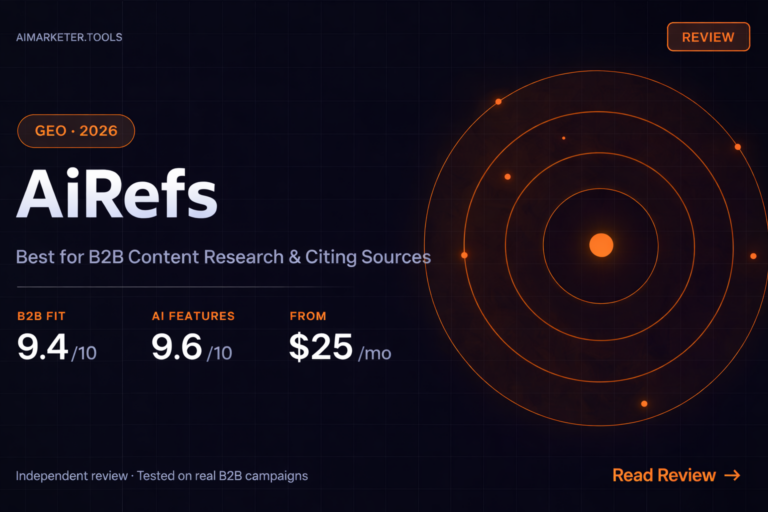
Airefs occupies a unique position in the AEO tool landscape. Where most platforms show you that you were cited (or not cited) in a ChatGPT response, Airefs shows you which specific URLs and sources ChatGPT drew from to construct that response, and critically, which third-party articles, Reddit threads, and forum discussions AI engines use in your category that you could target for backlinks, content, or community participation.
This source-intelligence capability changes how you can plan AEO content strategy. Instead of optimising your existing pages and hoping AI engines notice, you can identify the exact high-authority sources your target AI engines trust for your topic cluster, and build a strategy around earning citations on those sources. It is the difference between an AEO strategy that is reactive (track citations and respond) and one that is proactive (engineer the citation environment).
The platform also integrates AI crawler analytics, tracking how frequently GPTBot and other AI crawlers visit your site, with prompt monitoring, so you can correlate crawler activity with citation outcomes. This is a technically sophisticated capability that most platforms at this price point do not offer. At $24/month for the Starter plan, it is also the cheapest credible AEO tool in this guide.
The honest limitations are around depth. Airefs covers primarily ChatGPT at its entry tiers. If you need comprehensive multi-engine monitoring across Gemini, Perplexity, Copilot, and Google AI Overviews simultaneously, you will need to either upgrade or pair Airefs with a second tool. For teams with limited budgets, the Airefs + Otterly combination ($24 + $29 = $53/month) gives you source intelligence plus broad monitoring at a total cost lower than most single-tool alternatives.
Best-in-class for source intelligence. Stack with Otterly for a low-cost, high-insight AEO setup.
SemRush AI Toolkit
Semrush launched its AI Visibility Toolkit in March 2025, and the honest summary is: it is a solid extension of an already excellent SEO platform, not a standalone AEO powerhouse. If you are already paying for Semrush, adding the AI Toolkit for $99/month per domain is likely the most efficient first step into AEO monitoring you can take. The data lives in a platform your team already knows, the integration with keyword tracking and site audit workflows is seamless, and you avoid the cognitive overhead of learning a new tool.
What you get: AI Visibility Score (how often your brand appears in AI answers vs. up to 9 competitors), citation tracking across the major engines, sentiment analysis, and ContentShake AI for generating AEO-optimised content outlines. The ContentShake integration is a meaningful bonus — Semrush’s content tools have always been underrated, and combining AI visibility data with content recommendations creates a reasonable workflow for teams that do not want to purchase Writesonic GEO separately.
What you do not get: the prompt volume intelligence that Profound offers, the source-mapping capability of Airefs, or the specialised GEO depth of Otterly’s multi-engine tracking at entry pricing. The AI Toolkit is positioned as an add-on to Semrush’s core SEO workflow, which means AI visibility features feel like a second priority in the product’s information architecture — they are harder to navigate to and less fully developed than the legacy SEO features.
The affiliate programme is structured differently from recurring models: Semrush pays $200-$350 per sale (CPA flat fee) rather than ongoing commissions. For publishers, this means a higher single-transaction payout but no compound earnings over time. For buyers, it means no affiliate incentive is distorting our ranking of this tool — we are including it because it genuinely serves a large cohort of the B2B market.
The pragmatic choice for Semrush users. Do not buy Semrush just to get the AI Toolkit, buy Otterly or Airefs instead.
Peec AI
Peec AI is less well-known than the other tools in this guide, partly because it has focused on enterprise agency distribution rather than inbound marketing and SEO affiliate traffic. That distribution strategy is reflected in the product: Peec is designed for agencies that need to manage multiple brand profiles, generate client-ready reports, and communicate AEO value to non-technical stakeholders — all in a single workspace.
The monitoring capabilities cover the major AI engines (ChatGPT, Perplexity, Google AI Overviews, and others), and the competitive benchmarking features are strong enough for client pitch presentations. The agency-specific workflow — separate brand profiles, white-label reporting capability, and multi-client dashboards — is where Peec differentiates from tools like Otterly that are primarily built for single-brand use.
The primary limitation is transparency. Peec does not publish pricing publicly, which makes comparison difficult and forces prospects into a sales process before they can evaluate value. In a market where Otterly shows you exactly what you get for $29/month, being opaque about pricing is a friction that Peec’s agency target market is generally more tolerant of than growth-stage B2B teams evaluating tools independently.
For agencies, it deserves serious consideration alongside Scrunch AI (which does offer a 20% agency referral program).
A serious agency platform that deserves evaluation if you manage 5+ B2B clients. The pricing opacity is the main friction.
SE Visible
SE Visible is SE Ranking’s dedicated AEO product — a separate platform from their core rank tracker, built specifically for AI search visibility. SE Ranking has 13+ years of data accuracy reputation in the SEO market, and SE Visible benefits from that infrastructure: the data pipelines are more mature than many of the venture-backed AEO startups that launched in 2024-2025.
The platform covers five or more AI engines with daily monitoring, citation tracking, competitive benchmarking, and detailed reporting. For teams already using SE Ranking for SEO, the ability to pull AEO data from a trusted vendor with an established support track record and transparent pricing has meaningful appeal — you avoid adding yet another unknown startup to your tool stack.
The affiliate program is one of the most attractive in the category for publishers: 30% lifetime recurring commission with a 120-day cookie window and 14-day payout cycles. For aeoguide.io specifically, SE Visible is one of our priority affiliate relationships because the commission structure is strong and the product genuinely serves the mid-market B2B audience this site targets.
The limitation to flag honestly: SE Visible at $189/month (Core) is not cheap for teams at the evaluation stage. Compared to Otterly at $29/month for genuine entry-level tracking, SE Visible is priced for teams with an established AEO practice, not those just starting out. If you are earlier in your AEO journey, start with Otterly and graduate to SE Visible when your program justifies the spend.
The right upgrade path for SE Ranking users and a strong mid-market AEO platform with excellent affiliate terms.
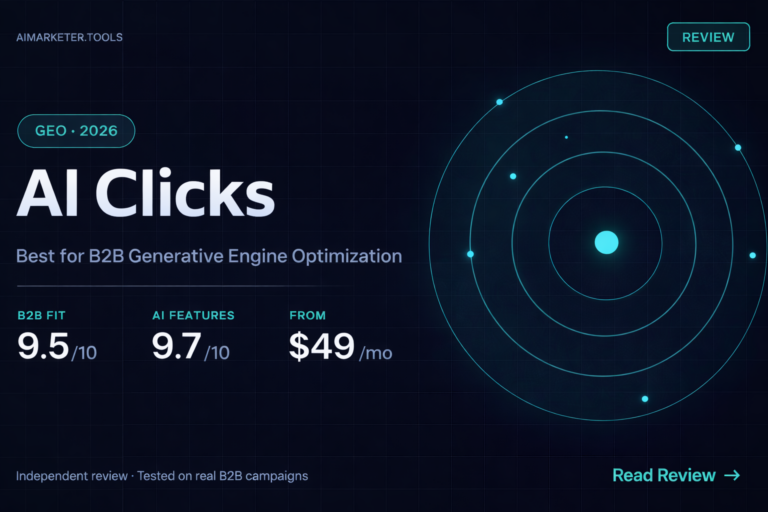
AI Clicks
AIclicks was built by its founder specifically to fill the AEO gap for marketers, agencies, and small B2B brands — and the product philosophy shows. Where enterprise tools prioritise data depth, AIclicks prioritises workflow clarity: the AI Search Visibility Dashboard is designed to be understood and acted upon by a generalist marketer, not a dedicated AEO analyst.
The standout feature is Prompt Cluster Mapping, which lets you group tracked prompts by topic cluster and tie visibility data back to traditional keyword research. For teams that are trying to build an AEO strategy that connects to their existing SEO content calendar, this cluster-level view is more practically useful than tracking isolated prompts in isolation. Citation Intelligence — showing which sources AI engines trust in your niche and why — complements Airefs’ similar capability at a different price point.
The free tier makes AIclicks genuinely accessible as a starting point, though the free plan’s coverage is limited. The competitive benchmarking and Geo Audit features sit behind paid tiers. For teams with a strict zero-budget constraint who want more than manual tracking, the free tier provides a meaningful baseline before committing to any paid tool.
The platform is younger and has less third-party validation than Otterly or Profound, which is worth noting. The 30% recurring affiliate programme is competitive, but the lower brand recognition means fewer independent reviews to cross-reference against vendor claims. We recommend treating the free tier as a genuine evaluation opportunity before committing to any paid plan.
A solid entry-level choice for budget-constrained B2B teams. Use the free tier to validate before upgrading.
AthenaHQ
AthenaHQ is a YC-backed AEO platform that has positioned itself between the accessibility of tools like Otterly and the enterprise scale of Profound. The YC backing matters in practice: it signals a certain pace of product development and the kind of strategic support that growth-stage companies find useful beyond the platform itself. The documented case studies — including a 10x citation growth outcome — give it credibility beyond the marketing deck.
The platform covers five or more AI engines including ChatGPT, Perplexity, Google AI Overviews, and Gemini, with citation tracking, competitive benchmarking, and an Enterprise-tier AI content agent with Deep Research capabilities. The Deep Research feature is more sophisticated than basic content recommendation tools: it uses AI to generate strategic recommendations for which topics to create and how to structure them for maximum citation probability.
The main barriers for most B2B marketing teams are the same as with Peec AI: no public pricing, no affiliate program, and a direct sales distribution model. AthenaHQ is not evaluating tool buyers the way Otterly or Airefs allow you to self-serve evaluate. You will talk to a sales rep before you see a number. For some teams, that hands-on onboarding is a feature. For teams that want to run a quick proof-of-concept before involving procurement, it is a friction.
We rank AthenaHQ at #9 not because the product is weak — the documented outcomes and YC validation suggest it delivers real value at its target segment — but because the evaluation friction and lack of affiliate program make it a harder recommendation for the self-service B2B marketing team that this guide primarily serves.
Worth evaluating for YC-stage startups and growth teams. Not suitable for teams that need immediate self-serve access.
PromptWatch
Promptwatch earns its place on this list primarily on the breadth of its engine coverage. Where most tools in this guide track four to six AI engines, Promptwatch covers ten platforms including ChatGPT, Perplexity, Google AI Overviews, Gemini, Copilot, Grok, Claude, Mistral, Meta AI, and others. If your B2B audience is early-adopter enough to be using a range of AI tools beyond the mainstream three, Promptwatch is the only tool in this guide that gives you full coverage without requiring Enterprise pricing.
The platform tracks brand mentions, citation frequency, sentiment, and competitive positioning across its engine set. At $99/month, it sits at the same price point as Semrush’s AI Toolkit and Profound’s Starter — but with genuinely broader engine coverage than either at that tier. The 25% recurring affiliate commission is competitive, though not the strongest rate in the category.
The honest limitations: Promptwatch has less third-party review volume than the category leaders, which makes it harder to independently validate vendor claims about data accuracy. It also has less brand recognition in the market, which can create internal stakeholder friction when trying to justify the spend against better-known alternatives. We rank it at #10 because these limitations are real, not because the coverage breadth is not valuable — for the right use case, it may well belong higher in your personal evaluation.
For most B2B teams, the mainstream engine coverage offered by Otterly or Writesonic GEO covers the vast majority of queries relevant to their buyers. But if you are tracking a market segment where DeepSeek, Mistral, or Meta AI have meaningful adoption — enterprise AI infrastructure, European markets, AI-native development teams — Promptwatch’s broader coverage is a genuine differentiator.
A niche pick for teams that genuinely need coverage beyond the mainstream five. Start with Otterly if you are not sure you need it.
Frequently asked questions for AEO and GEO
What is the best AEO tool for small B2B teams on a budget?
Otterly.ai at $29/month or Airefs at $24/month are the clearest entry points. Both offer genuine multi-engine tracking without enterprise pricing. Otterly has broader recognition (Gartner Cool Vendor 2025, 20,000+ users) while Airefs leads on source-level intelligence, showing which exact articles AI engines cite. Start with a free trial on both before committing.
Do I need a dedicated AEO tool or can I use Semrush?
It depends on your priorities. If AI visibility is your primary concern and you need prompt-level data, citation tracking, and content recommendations, a dedicated tool (Otterly, Profound, Writesonic GEO) outperforms the Semrush AI Toolkit. If you’re already deep in the Semrush ecosystem and want to add a layer of AI monitoring without switching platforms, the toolkit is a pragmatic add-on. The two approaches are not mutually exclusive.
How many AI engines should an AEO tool track?
The minimum viable coverage in 2026 is ChatGPT, Google AI Overviews, and Perplexity — these three engines account for the vast majority of B2B research queries. Gemini and Copilot are secondary priorities. Tools that track 6+ engines are ideal; tools that only cover ChatGPT at entry pricing (like Profound Starter) create a false sense of coverage.
What metrics should I track to measure AEO success?
The core KPI framework: (1) Citation Rate, how often your brand appears in AI answers for your target prompts; (2) Share of Voice, your citations vs. competitors’; (3) Citation Drift, month-over-month change in citation sources; (4) Sentiment, whether AI mentions are positive, neutral, or negative; (5) Source diversity, how many of your URLs are cited across engines. Note that citation drift of 40-60% per month (per Profound’s research) means weekly tracking is more useful than monthly snapshots.
How do AEO tools handle Google AI Overviews specifically?
Google AI Overviews require separate tracking infrastructure because they are embedded in traditional search results, not a standalone chatbot. Tools with dedicated AI Overview tracking include Otterly.ai, Semrush AI Toolkit, SE Visible, and Writesonic GEO. Profound covers Google AI Overviews on its higher tiers. Note that Google AI Overviews citation rates are significantly lower than Perplexity or ChatGPT (approximately 3-5% vs 28% for Copilot, per GenOptima’s data), but their reach is vastly larger given Google’s overall search volume.