AEO Strategy for B2B: The Complete Playbook for AI Visibility in 2026
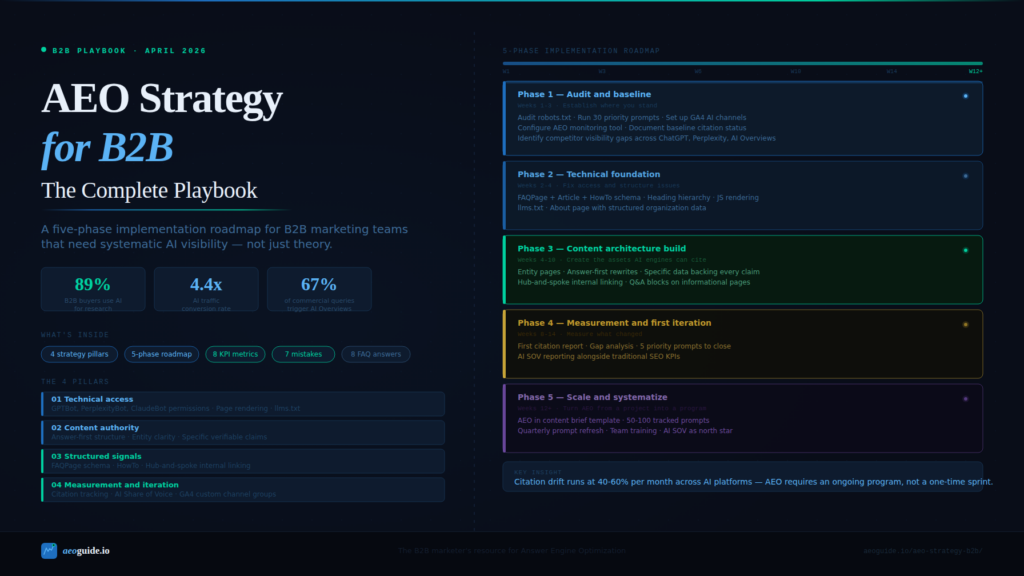
What is an AEO strategy for B2B? It is a structured, repeatable program for making your brand visible inside AI-generated answers on ChatGPT, Perplexity, Google AI Overviews, and Gemini — the platforms where an increasing proportion of B2B buying research now begins.
This page gives you the complete playbook. Not the theory — you can read the theory in our guide to what AEO means. This is the operational document: a five-phase implementation roadmap, a KPI framework built for B2B reporting environments, a content architecture that AI engines can actually parse, and honest guidance on the tool stack you need to run the program.
The starting assumption is that you are a B2B marketing team that understands the category and needs to build or sharpen a program. If you are still at the definitional stage, start with our AEO fundamentals guide first and come back here.
Why B2B teams need a formal AEO strategy in 2026
The case for AEO is no longer theoretical. Forrester research shows that 89% of B2B buyers now use generative AI as a key source during self-guided research. ChatGPT processes 2.5 billion prompts per day. Perplexity has reached 780 million monthly queries, with disproportionate usage among professionals and researchers , your buyers. Google AI Overviews now appear on 67% of commercial investigation queries, the category of searches that B2B buyers run when evaluating solutions.
When a VP of Operations asks ChatGPT ‘What is the best project management tool for a distributed engineering team of 50?’, she gets a structured answer with four or five named solutions. If your product is not among them, you are invisible to that buyer at the moment she is forming her initial shortlist. No click happens. No session is recorded in your analytics. No impression shows in Google Search Console. The evaluation proceeds without you.
The strategic implication is straightforward. AEO is not a replacement for SEO , foundational technical SEO is a prerequisite for AI crawler access. It is an additional layer of optimization designed for a distribution channel that your existing tools cannot measure and your existing content formats are not optimized for. A formal program, with defined ownership, KPIs, tooling, and quarterly reviews, is the difference between accidental citation and systematic visibility.
The four pillars of a B2B AEO strategy
Before the phases, the conceptual framework. A coherent AEO strategy rests on four pillars, each of which requires distinct tactics and distinct measurement. Teams that skip one of these pillars find that their program stalls , usually at the evaluation layer.
Pillar 1: Technical access
AI crawlers cannot cite pages they cannot reach. This sounds obvious, and most teams do not consider it a gap , until they check their robots.txt and discover they have inadvertently blocked GPTBot or PerplexityBot. The technical access pillar covers crawler permissions, page rendering (content must be accessible without JavaScript execution), site speed, and the emerging practice of publishing an llms.txt file that communicates your content structure to language models directly.
Pillar 2: Content authority
This is where most AEO investment should be directed, and where most teams underperform. AI engines evaluate candidate pages for how directly and credibly they answer the query , not how many keywords they contain. Content authority means writing that leads with answers, uses short self-contained paragraphs, names entities explicitly rather than relying on pronouns and generic nouns, backs claims with specific verifiable data, and covers the topic at the depth the query complexity deserves. See our AEO content checklist for the complete 15-point framework.
Pillar 3: Structured signals
Schema markup is the machine-readable layer that tells AI crawlers what type of content a page contains and what questions it answers. FAQPage schema is the highest-impact implementation for most B2B content teams. Article, HowTo, and Product schemas contribute meaningfully for their respective content types. Beyond schema, topical clustering , a hub-and-spoke architecture where a pillar page links to satellite articles and satellites link back , provides the internal signal of topical authority that AI engines use to decide which sources to trust on a given subject.
Pillar 4: Measurement and iteration
An AEO program without measurement is content production with an uncertain purpose. The measurement pillar covers citation tracking (which prompts trigger citations, how often, in which position), AI Share of Voice against competitors, sentiment monitoring, and the connection of AI visibility metrics to business outcomes via GA4 custom channel groups. The KPI framework in Section 5 of this guide gives you the complete measurement architecture.
Prompt mapping: the strategic starting point
Every AEO strategy begins with the same exercise: building a prompt library. A prompt library is a structured set of the questions your buyers are actually typing into AI tools , not keyword fragments, but full conversational queries.
The distinction from keyword research is significant. A keyword-based approach produces a list like ‘project management software B2B’. A prompt-based approach produces queries like ‘What project management tool should a distributed engineering team of 50 use if they need Jira integration and a mobile-first experience?’ These are different animals. AI engines answer the second type. Your content needs to address it directly.
How to build your prompt library
- Define your ICP and buying scenarios. For each major buyer persona, write out the three to five research questions they would ask during the evaluation phase of a purchase decision in your category. Be specific about context: company size, use case, constraints, existing tool stack.
- Run each prompt across ChatGPT, Perplexity, and Google AI Overviews. Document which brands are cited, in which order, and whether your brand appears. This is your baseline gap analysis , the document you use to make the internal case for AEO investment.
- Expand to 30-50 prompts covering the full funnel: awareness queries (‘What is [your category]?’), evaluation queries (‘Best [category] for [use case]’), comparison queries (‘[Your brand] vs [competitor]’), and objection queries (‘Is [your category] worth it for a company of [size]?’).
- Categorize prompts by intent, AI engine coverage, and current citation status. The prompts where competitors are cited but you are not become the priority content targets for Phase 2.
- Refresh the prompt library quarterly. AI engine behavior changes , citation drift runs at 40-60% per month , which means prompts that trigger citations today may not trigger the same citations in 90 days. The prompt library is a living document, not a one-time audit.
Content architecture for AI citation
A prompt library tells you what to write. Content architecture determines how to structure what you write so AI engines can extract, trust, and cite it. The structural requirements for AEO citation differ meaningfully from traditional SEO content formats.
The entity page , your most important AEO asset
Every concept, product, or solution your brand is associated with needs a dedicated entity page. An entity page is a standalone, definitional document that answers three questions clearly and unambiguously: What is this thing? What does it do? How does it relate to adjacent concepts?
AI engines build knowledge graphs from entity relationships. A brand that has clear, consistent, well-linked entity pages for each of its products and key concepts is a brand that AI engines can recommend with confidence. A brand whose product definitions are scattered across marketing copy, blog posts, and landing pages that all use different terminology is a brand AI engines struggle to cite accurately.
Entity pages should be short , 600 to 900 words is usually sufficient. They should define the concept precisely in the first paragraph, include FAQPage schema, link to deeper content for readers who need more, and cross-link to related entity pages. They are not blog posts or thought leadership content. They are reference documents.
The pillar page , authority through depth
Pillar pages cover a topic comprehensively. This page is one. A well-constructed pillar page gives AI engines multiple extraction anchors , the content immediately following each H2 or H3 is more likely to be pulled as a citeable unit , while the overall depth and internal linking structure signals topical authority.
The minimum viable pillar page for AEO purposes covers the topic definition, the strategic framework, implementation guidance, a measurement section, a comparison table or decision framework, and a FAQ block. Every section should be structured so it answers a distinct question directly, without requiring the reader to have read the preceding section for context.
The hub-and-spoke linking architecture
No single page, however well-written, establishes topical authority on its own. AI engines, like traditional search engines, use link structure as a proxy for expertise. A pillar page that links to 8-10 satellite articles, each of which links back to the pillar and cross-links to adjacent satellites, creates a citation network that AI engines can navigate and trust.
The AEO KPI framework for B2B marketing teams
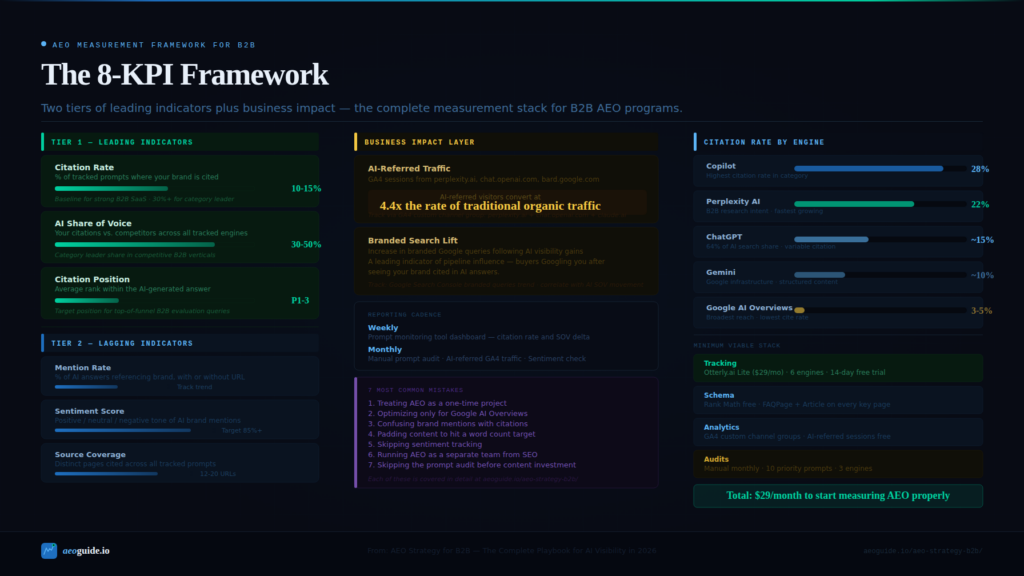
AEO measurement requires a fundamentally different framework than SEO. Traditional SEO metrics , rankings, impressions, organic traffic , explain only 4-7% of AI citation behavior according to research from Austin Heaton’s measurement practice. You need a separate set of KPIs designed for a zero-click, citation-driven environment.
The framework below organizes eight metrics into two tiers and a business impact layer. Tier 1 metrics are leading indicators , they move first and tell you whether your program is working before you see it in traffic or revenue. Tier 2 and business metrics provide competitive and commercial context.
KPI | What it measures | Tier | Benchmark (B2B) | Tool |
Citation Rate | % of target prompts where your brand is cited | 1 , Leading | 10-15% baseline · 30%+ leader | Otterly, Profound, Airefs |
AI Share of Voice | Your citations vs. competitor citations across all engines | 1 , Leading | 30-50% for category leader in B2B verticals | Profound, SE Visible, Writesonic GEO |
Citation Position | Average rank of your brand within AI-generated answer | 1 , Leading | Position 1-3 for top-of-funnel queries | Otterly, Profound |
Mention Rate | % of AI answers that reference your brand (with or without URL) | 2 , Lagging | Varies by brand maturity , track trend vs. baseline | Writesonic GEO, Otterly |
Sentiment Score | Tone of AI mentions: positive / neutral / negative | 2 , Lagging | Target >85% positive mentions | Otterly, Writesonic GEO |
Source Coverage | Number of distinct pages cited across all tracked prompts | 2 , Lagging | 12-20 distinct URLs for top B2B performers | Airefs, Profound |
AI-Referred Traffic | GA4 sessions from perplexity.ai, chat.openai.com etc. | Business | Small but 4.4x higher conversion rate | GA4 custom channel groups |
Branded Search Lift | Increase in branded queries following AI visibility gains | Business | Leading indicator of pipeline influence | Google Search Console + trend tracking |
How to build the reporting stack
The complete B2B AEO reporting stack combines three layers:
- AI citation monitoring tool: A dedicated AEO platform (Otterly, Profound, Airefs, SE Visible , see our full tool comparison) that tracks citation frequency, position, and competitive SOV automatically across your tracked prompt set. This is the non-negotiable layer , manual tracking breaks down beyond 20 prompts across two engines.
- GA4 custom channel groups: Create a custom channel group in GA4 that captures AI-referred sessions from perplexity.ai, chat.openai.com, bard.google.com, bing.com/chat, and claude.ai. This lets you report AI-attributed traffic and conversion rate separately from organic search.
- Manual prompt audits: Run your 10 highest-priority prompts manually across ChatGPT, Perplexity, and Google AI Overviews monthly. Document the full response, citation list, and brand position. This qualitative audit catches nuances (sentiment, how your brand is described, what competitors are cited alongside you) that automated tools may miss.
Platform-specific optimization tactics
The core AEO content principles apply across all AI engines. But each platform has distinct retrieval behavior and citation patterns that reward specific tactics. A strategy that treats all four engines identically will underperform against one that accounts for these differences.
ChatGPT (OpenAI) , Conversational depth and entity clarity
ChatGPT with browsing rewards conversational content that anticipates follow-up questions. Its citation behavior is less consistent than Perplexity , it does not always surface sources , but its volume (64% of AI search share) makes it the highest-priority platform. Focus on: entity pages with precise definitions, content that answers multi-part questions in sequence, and strong domain-level credibility signals (named authors, About pages, consistent entity terminology across your site).
Perplexity AI , Data specificity and source citation
Perplexity cites sources consistently and favors data-heavy content with clear attribution. It functions more like a research tool than a conversational assistant, which means its users are in a more deliberate research mode , typically higher intent than ChatGPT queries. Focus on: pages with specific statistics and named sources, content with strong third-party validation (analyst citations, customer data, proprietary research), and FAQPage schema that matches the exact phrasing of research queries.
Google AI Overviews , Traditional SEO signals plus AEO structure
Google AI Overviews draw from indexed content that already performs well in traditional search, but use a different retrieval mechanism than blue-link rankings. They strongly favor pages with FAQPage schema, clear H2/H3 structure that mirrors natural language queries, and content that passes Google’s E-E-A-T signals (Experience, Expertise, Authoritativeness, Trustworthiness). Commercial investigation queries trigger AI Overviews on 67% of searches , the queries where B2B buyers are evaluating solutions. This is the platform with the broadest reach for B2B visibility.
Gemini , Structured comparison content
Gemini (Google’s standalone AI assistant, distinct from AI Overviews) responds well to structured comparison content and content organized around clearly defined alternatives. For B2B brands, this means comparison pages ([Your product] vs [competitor]), decision frameworks, and structured lists of features organized by use case. The Google infrastructure behind Gemini means that existing Google Business Profile completeness and Google-indexed authority contribute to Gemini citations.
The five-phase AEO implementation plan
This roadmap is designed for a B2B marketing team building an AEO program from scratch or formalizing an ad hoc approach. Phases 1 and 2 can run in parallel. Phases 3 through 5 are sequential.
Phase 1: Audit and baseline · Weeks 1-3 Establish where you stand before spending resources on optimization.
|
Phase 2: Technical foundation · Weeks 2-4 Fix access and structure issues , the prerequisites for everything else.
|
Phase 3: Content architecture build · Weeks 4-10 Create or rewrite the content assets that AI engines can cite.
|
Phase 4: Measurement and first iteration · Weeks 8-14 Measure what changed, identify what to fix next.
|
Phase 5: Scale and systematize · Weeks 12+ Turn AEO from a project into a program.
|
The seven most common B2B AEO strategy mistakes
Most AEO programs that fail do not fail because the tactics are wrong. They fail because of structural or organizational mistakes that undermine even good content work. These are the patterns we see most often.
Treating AEO as a one-time project
Citation drift runs at 40-60% per month across major AI platforms. The sources AI engines cite change constantly as models update and new content enters the index. An AEO audit performed once and filed away produces one quarter of improvements, then decays. AEO requires ongoing monitoring, quarterly prompt refreshes, and regular content updates. Budget for a program, not a project.
Optimizing only for Google AI Overviews
Google AI Overviews are important , they have the broadest reach. But they cite sources at only 3-5% of queries. Perplexity cites at 22% and is growing rapidly among B2B researchers. Copilot cites at 28%. A strategy that treats AI Overviews as the only target misses the platforms with higher citation frequency and high-intent B2B usage.
Confusing mentions with citations
An AI engine that mentions your brand name in a response without linking to your content is not the same outcome as one that cites your page as a source. Mentions build awareness. Citations build authority and referral traffic. Your KPI framework should track both separately and prioritize growing owned citations over third-party mentions.
Padding content to hit a word count
AI engines, particularly Claude and ChatGPT, have been trained on enough content to recognize padding. A 4,000-word page that makes 800 words of actual argument and fills the rest with restatements does not perform better than a tight 1,200-word page that answers the question precisely. Match depth to complexity of query, not to an arbitrary length target.
Not measuring sentiment
Being cited is not always positive. If AI engines consistently describe your brand as ‘a budget option’ or ‘suitable for small teams’ when you target enterprise, your citation rate metric looks healthy but your commercial positioning is being undermined at scale. Sentiment tracking is not optional , it is how you catch narrative problems before they compound.
Assigning AEO to a separate team from SEO
The content tactics overlap. The measurement tools need to integrate. The internal linking architecture is shared. Teams that build an ‘AEO squad’ separate from the SEO team create duplication, territorial conflicts, and content that optimizes for one channel at the expense of the other. Assign AEO KPIs to your existing content and SEO team, with additional tooling and a quarterly AEO-specific review.
Skipping the prompt audit before investing in content
The fastest way to waste AEO budget is to produce content for queries your buyers are not typing into AI tools. Traditional keyword research does not map reliably to AI prompt behavior. Always build the prompt library first, run the baseline audit, and let the gap analysis drive your content investment. The prompts where competitors are cited and you are not are the content priorities. Everything else can wait.
Frequently asked questions
How long does it take to see results from an AEO strategy?
Early citation signals are detectable within 4-8 weeks of implementing structural content changes , particularly answer-first rewrites, FAQPage schema, and entity clarity improvements. Meaningful citation frequency improvements on competitive category queries typically take 3-6 months. AI Share of Voice gains that show up in pipeline and branded search lift are a 6-12 month horizon. AEO is not a quick-win channel. Teams that expect 30-day results will abandon the program before it compounds. The correct frame is editorial discipline over 2-3 quarters, not a one-off sprint.
Should AEO be a separate program from SEO, or integrated?
Integrated, with distinct KPIs. The content tactics overlap significantly , answer-first structure, schema markup, topical depth, entity clarity , and a page that performs well in AEO tends to also perform better in traditional search. The mistake is treating AEO as a bolt-on module managed by a different team. Assign AEO KPIs (citation rate, AI share of voice) to the same team that owns SEO KPIs, and build a unified content brief template that addresses both. Budget separately for AEO tooling (citation tracking) since traditional SEO tools do not measure it.
Which AI engine should a B2B team prioritize?
Concentrate 80% of initial AEO effort on ChatGPT (64% of AI search share), Google AI Overviews (broadest reach in traditional search), and Perplexity (highest citation frequency per query and disproportionate B2B professional usage). Gemini and Copilot are secondary priorities , meaningful but less urgent. Note that citation behavior varies significantly by platform: Copilot cites sources at roughly 28% of queries, Perplexity at 22%, Google AI Overviews at 3-5%. The low AI Overview citation rate does not make it unimportant , its reach across traditional Google search volume compensates.
Does a page need to rank well in Google to be cited by AI engines?
No , and this is one of the most counterintuitive findings in AEO. Research from Discovered Labs shows only 8-12% overlap between URLs cited by ChatGPT and top-10 Google organic rankings for commercial B2B queries. For product comparison queries, the correlation is negative. A page with modest traditional rankings but exceptional structural clarity , direct answers, schema markup, entity specificity , can outperform high-authority pages in AI citations. This creates a genuine opportunity for smaller B2B brands to compete with established players in AI search before they can match them in traditional SEO.
What is an llms.txt file and does my B2B site need one?
An llms.txt file is a structured text file placed at the root of your domain (yourdomain.com/llms.txt) that communicates to AI crawlers which sections of your site are most relevant for citation, what your company does, and how your content should be understood. It is analogous to robots.txt but designed for language models rather than traditional crawlers. Not all AI engines currently read it, but early adoption signals technical credibility and may become increasingly important as the standard matures. For B2B sites with complex product lines or multiple audience segments, an llms.txt that clearly defines your category and key content assets is a low-effort, potentially high-value technical investment.
How do I handle AEO for a B2B brand with multiple products or solutions?
Create separate entity pages for each product , a dedicated page that defines what the product is, what problem it solves, which use cases it addresses, and how it compares to alternatives. AI engines need clear, standalone definitions for each entity your brand represents. A single ‘Our Solutions’ page that lists all products without individually defining them creates entity ambiguity. Build internal links between product entity pages and the category-level content that covers the broader market. This architecture makes your product namespace legible to language models and distributes topical authority across your full product range rather than concentrating it on a single page.
Conclusion about AI Visibility in 2026
An AEO strategy is not a destination , it is an operating rhythm. The brands that will dominate AI citations in 2027 are the ones running consistent programs today: tracking prompts weekly, refreshing content quarterly, expanding their entity footprint systematically, and reporting AI Share of Voice alongside traditional search metrics in every leadership review.
The barrier to entry is lower than it looks. You do not need a dedicated AEO team, an enterprise budget, or a technical SEO specialist. You need a monitoring tool at $29/month, a content team that can implement the 15-point AEO checklist, a quarterly prompt refresh process, and the organizational patience to measure a program over two or three quarters rather than expecting a 30-day return.
The three most important next steps: run your 10 most commercially important buyer prompts in ChatGPT and Perplexity today and document who is cited. Implement FAQPage schema on your top five informational pages this week. And if your team is not yet tracking AI citations automatically, read our guide to the best AEO tools for B2B marketers to choose the right monitoring platform for your budget and maturity.
The AEO visibility gap between brands that move now and brands that wait is not theoretical. It is measurable, it is growing, and in most B2B categories it has not yet closed. That window is the opportunity this playbook is designed to help you capture.