AEO Content Checklist: 15 Points to Optimize Any Page for AI Engines
What is an AEO content checklist? An AEO content checklist is a structured set of on-page criteria that increase the probability of your content being selected and cited by AI answer engines — ChatGPT, Perplexity, Google AI Overviews, Gemini — when they generate responses to user queries.
If you have ever wondered why a competitor’s page gets cited in AI answers while yours does not, the gap is rarely about writing quality. It is almost always structural. AI engines do not reward prose — they reward clarity, specificity, and the right technical signals. This checklist gives you a concrete, repeatable process to close that gap on any page you publish.
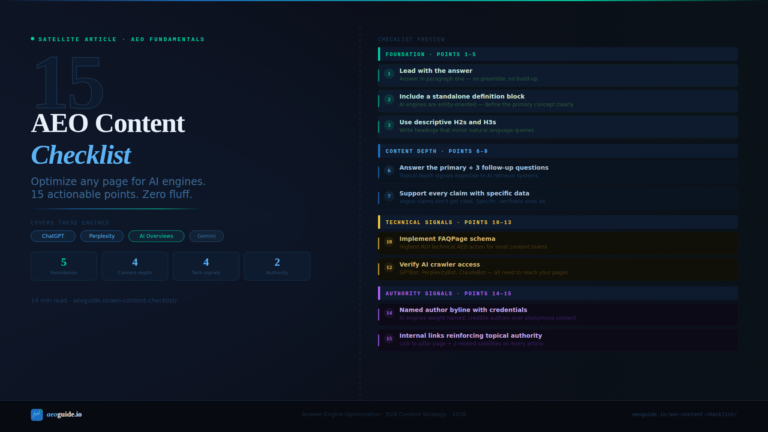
Work through these 15 points in order. Some take two minutes. Some require a genuine rewrite. All of them matter.
The Foundation: Structure AI Engines Can Parse
1. Lead with the answer
The single most impactful change you can make to any page is moving the answer to the first paragraph. AI engines retrieve content by relevance and evaluate it by how directly it addresses the query. A page that makes the reader wade through context and background before delivering the answer trains AI models to look elsewhere.
State what the page is about and what the reader will learn in the first 40 to 60 words. Then expand. The inverted pyramid is not a new idea — it is just more consequential now than it was in the SEO era.
2. Include at least one explicit definition block
AI engines are entity-oriented. When they encounter a page that defines a concept clearly — what it is, what it does, and how it relates to adjacent concepts — they are significantly more likely to use that page as a citation source for definition queries.
Write a definition block for the primary concept on every page. Format it so it reads as a standalone unit: a short paragraph that could be extracted and quoted verbatim. Do not bury the definition in the middle of a longer paragraph.
3. Structure the page with descriptive H2s and H3s
Heading structure does two things for AEO. First, it gives AI crawlers a navigational map of your content, which improves retrieval accuracy. Second, many AI engines use headings as extraction anchors — the content immediately following an H2 or H3 is more likely to be pulled as a citeable unit than content in the middle of a long section.
Write headings that describe what the section answers, not just what it covers. “How to add FAQPage schema to WordPress” is more extractable than “Schema implementation.” Match your headings to the natural language queries your audience types into AI tools.
4. Keep paragraphs short and self-contained
A paragraph that makes one clear point is more useful to an AI engine than a paragraph that makes three connected points. When an AI system extracts a section of text to include in a generated answer, it pulls a unit of meaning. Long, multi-idea paragraphs get truncated or skipped.
Four to six sentences per paragraph as a working maximum. Each paragraph should be readable in isolation without requiring context from the paragraph before it.
5. Use numbered or bulleted lists for processual content
Any content that describes steps, criteria, comparisons, or collections performs better in AI search when formatted as a list rather than prose. Perplexity in particular shows a strong preference for structured list content when answering “how to” and “what are” queries.
The formatting rule is simple: if you can reasonably number it, number it. Reserve prose for context, explanation, and argument. Use lists for the content itself.
Content Depth: What AI Engines Evaluate
6. Answer the primary question and the three most likely follow-up questions
A single well-answered question might earn you one citation. A page that anticipates what the reader asks next — and answers those questions too — builds topical depth that AI engines associate with expertise. Perplexity and ChatGPT both show a preference for sources that cover a topic comprehensively rather than sources that answer one narrow question well.
Before you publish, identify the three questions a reader would naturally ask after reading your main answer. Add a section, a callout, or an FAQ block that addresses each one.
7. Include specific data, statistics, or named examples
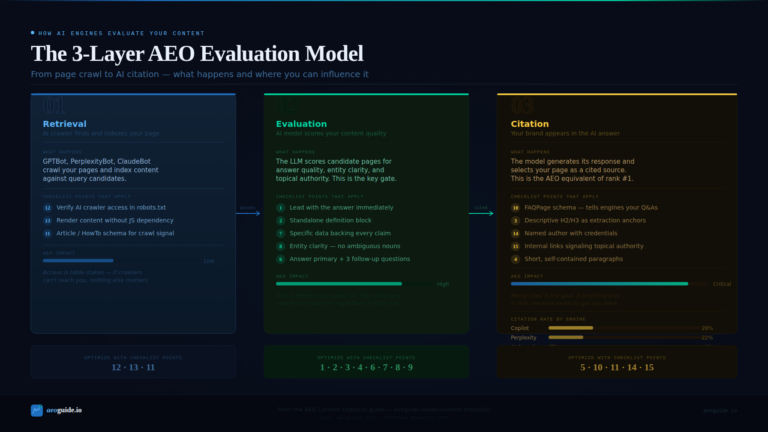
Vague claims do not get cited. Specific, verifiable ones do. “Many marketers report improved AI visibility after implementing schema” is ignorable. “Otterly.ai’s 2026 citation study across 1M+ AI responses found that pages with FAQPage schema were cited 34% more frequently than equivalent pages without it” is quotable.
Every major claim on your page should be supported by a specific figure, a named source, or a concrete example. If you do not have proprietary data, cite credible third-party research directly — with attribution. AI engines weight pages that cite sources more heavily than pages that assert without evidence.
8. Establish entity clarity throughout the page
Entity clarity means making unambiguous what every important noun on your page refers to. “The tool” is ambiguous. “Otterly.ai” is not. “The platform” requires context. “Perplexity AI’s citation tracking feature” does not.
This is not about keyword repetition — it is about semantic precision. AI language models build knowledge graphs from text. Pages that name entities clearly and consistently give those models better signal to build on. Go through your draft and replace every ambiguous pronoun or generic noun with the specific entity it refers to.
9. Cover the topic at the depth the query deserves
There is no universal word count target for AEO. A page answering “what is FAQPage schema” does not need 3,000 words. A page covering “how to build a complete AEO content strategy for a B2B SaaS company” probably does. The correct depth is the minimum required to answer the topic authoritatively, with nothing important missing.
What you should avoid is padding. AI engines — particularly Claude and ChatGPT — have been trained on enough content to recognise when a page is adding length without adding value. Thin content dressed up with subheadings does not perform better than thin content without them.
Technical Signals: What AI Crawlers Need
10. Implement FAQPage schema on every informational page
FAQPage schema is the highest-ROI technical AEO action available to most content teams. It tells AI crawlers and Google’s systems exactly which questions your page answers and what the answers are — in a machine-readable format that does not require any inference or extraction.
The implementation is straightforward in WordPress using a plugin like Rank Math or Yoast. Add at minimum three FAQ items per page, matching the natural language questions your audience uses in AI tools. Avoid generic questions like “What is [topic]?” — use the specific questions that appear when you type your topic into Perplexity or ChatGPT’s search.
11. Add Article or HowTo schema where relevant
Beyond FAQPage, Article schema establishes the basic metadata that AI crawlers use to evaluate freshness, authorship, and content type. HowTo schema is directly useful for process-oriented pages — it gives AI engines a structured representation of steps that can be extracted and presented in generated answers.
If your page describes a process with discrete steps, implement HowTo schema. If it is editorial or analytical content, implement Article schema. If it answers specific questions, add FAQPage schema on top of either. These are not mutually exclusive.
12. Ensure AI crawlers can access your page
A technically sound page that AI crawlers cannot reach does not exist from an AEO perspective. Check your robots.txt file to confirm that GPTBot (OpenAI), PerplexityBot, Google-Extended, and ClaudeBot are not blocked. A surprisingly large number of sites block some or all of these crawlers inadvertently through overly broad directives.
Use your server logs or a crawler analytics tool to verify that AI bots are visiting your key pages. Airefs, for example, provides AI crawler analytics as part of its monitoring dashboard. If crawlers are visiting but citations are not following, the problem is content quality or structure. If crawlers are not visiting at all, the problem is access.
13. Make your page load fast and render without JavaScript dependency
Page speed affects AI crawler efficiency. Crawlers, like users, do not wait indefinitely for slow pages. More importantly, some AI crawlers do not execute JavaScript — which means that if your critical content is rendered client-side, those crawlers may retrieve an empty shell rather than your actual content.
Test your key pages with JavaScript disabled. If the primary content disappears, you have a rendering problem that is harming your AI visibility. The fix is server-side rendering or static HTML for content that needs to be crawlable.
Authority Signals: Why AI Engines Should Trust You
14. Include a clear author byline with credentials
AI engines weight content from named, credible authors more heavily than anonymous content. This is particularly true for YMYL-adjacent topics — business decisions, marketing strategy, financial tools — where expertise signals matter. A byline that includes the author’s name, their relevant experience, and a link to their profile gives AI systems a data point to evaluate trustworthiness.
Write a two to three sentence author bio for every piece you publish. Include specific credentials rather than vague ones: “10 years in B2B content strategy, previously at [Company]” outperforms “expert marketer.” Link the author name to a profile page that itself contains structured data.
15. Build internal links that reinforce topical authority
A single well-optimised page is a weak signal. A cluster of internally-linked pages that cover a topic from multiple angles is a strong one. AI engines, like traditional search engines, use link structure to assess which domains and pages carry genuine authority on a given subject.
Every article you publish should link to its parent pillar page and to at least two related satellite articles. The pillar page should link back to all its satellites. This is not just SEO hygiene — it is the architecture that makes topical authority legible to AI systems that are trying to decide which sources to trust.
The Full Checklist at a Glance
Foundation
- Answer in the first paragraph — no preamble, no build-up
- Include a standalone definition block for the primary concept
- Use descriptive H2s and H3s that mirror natural language queries
- Keep paragraphs to one idea, four to six sentences maximum
- Format processual content as numbered or bulleted lists
Content depth
- Answer the primary question plus three likely follow-up questions
- Support every major claim with a specific stat, figure, or named example
- Replace ambiguous pronouns and generic nouns with specific entity names
- Match content depth to query complexity — no padding, no missing context
Technical signals
- Implement FAQPage schema on every informational page
- Add Article or HowTo schema where content type warrants it
- Verify AI crawler access in robots.txt and server logs
- Confirm content renders without JavaScript dependency
Authority signals
- Publish with a named author byline and specific credentials
- Link internally to the pillar page and at least two related satellite articles